The short answer
Ipe deck restoration in Bellingham: clean, brighten, and oil a grey deck back to brown, what it costs in 2026, and when an annual oil coat is enough.
If you would rather skip the reading and just get a number for your own place, that takes about two minutes.
If you have an Ipe deck in Bellingham, you already know it is a different animal from a cedar or pressure-treated board. You also know what our weather does to it. After a winter or two of wet months and marine air, that deep chocolate brown fades to a flat silver-grey, and a lot of owners assume the wood is past saving. It is not. The color you fell in love with is still right there under the surface, and getting it back is more about technique than muscle.
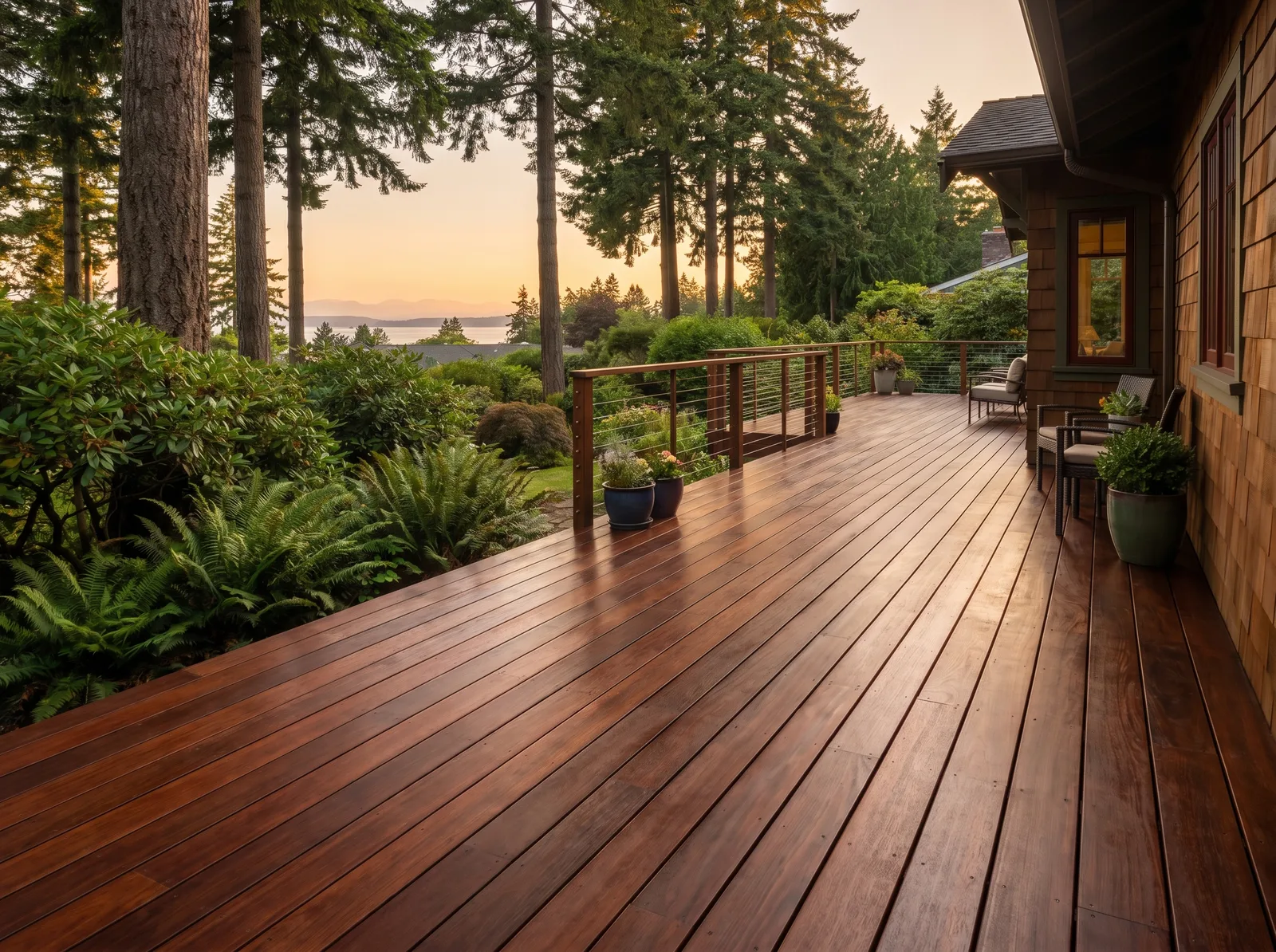
We work on Ipe two ways. The first is full refurbishment, where we gently clean the deck, brighten out the grey, and re-oil to lift the original color back to the surface. The second is annual oil treatment, a lighter maintenance visit that keeps that color from washing out again. Here is how both work, what each one costs in Whatcom County in 2026, why Ipe needs a different approach than a softwood deck, and how to tell which service your deck actually needs. If you want the broader picture first, our deck staining and refinishing page covers the full range of work we do on Bellingham decks, and if someone has told you the boards are too far gone, read deck restoration versus replacement before you agree to a tear-out.
What Makes Ipe Different (and Why It Goes Grey)
Ipe, sometimes sold as Brazilian walnut, is one of the densest decking materials you can buy. Understanding that density is the key to everything else, because it changes how the wood weathers and how it has to be finished.
A hardwood that outlasts the house
Ipe is dense enough to sink in water and hard enough to dull saw blades. On the Janka hardness scale it sits close to three times harder than red oak, which is why it shrugs off the rot, insects, and decay that would chew through a softwood deck, and why a properly installed Ipe deck can last decades along Bellingham Bay where salt air is hard on everything. The boards you have are almost certainly structurally fine, even if they look tired. Weathering on Ipe is a surface story, not a structural one.
The silver patina is only skin deep
The grey you see is UV damage to the very top layer of the wood. Sunlight breaks down the lignin that binds the surface fibers, and the result is that washed-out, pewter look. That weathered layer is thin, a fraction of a millimeter on most decks. Clean through it and the warm reddish-brown is sitting right underneath, unchanged. Restoration is about removing a shallow weathered layer and protecting what is below, not about replacing boards.
Can Ipe that has been grey for years still come back?
Usually, yes. The grey does not keep getting deeper year after year, because UV only ever reaches the top fibers. A deck that has been ignored for five years cleans and brightens back about as well as one ignored for two. What actually changes with time is everything growing on top of the grey: mildew staining, black spotting on the shaded elevations, and moss packed into the board gaps. That is cleaning work, not lost wood. Two things do not wash out. Dark iron staining around steel fasteners, where the metal has reacted with the tannins in the wood, sometimes lightens with oxalic acid and sometimes stays. And physical damage, meaning raised splinters or surface checking from years of wet and dry cycles, needs sanding rather than washing. Here is a check you can run yourself this afternoon. Wet a rag and rub hard on a hidden board near the house wall. If brown shows through, the color is still in there and cleaning plus brightening will bring the whole deck back.
Why our wet months speed up the weathering
Bellingham gives Ipe a specific kind of beating. The grey itself comes from UV, but our long wet months add moss spores, mildew bloom, and a damp surface that never fully dries on the shaded elevations. Decks tucked under Chuckanut shade or ringed by trees in Sudden Valley grey unevenly and grow more mildew, and the north side always goes first. Waterfront decks in Edgemoor and along the Fairhaven shoreline get salt on top of all that. The deck does not fail, but it looks neglected faster here than it would in a dry climate.
You do not have to read the whole guide. A free quote for your own project takes about two minutes.
Get a free quoteWhy Film Finishes Fail on Ipe
Before getting into our process, it helps to know what does not work, because the wrong product is the most common reason an Ipe deck looks bad a year after someone finished it.
Too dense to hold a film
Solid stains, polyurethanes, and many deck sealers form a film that sits on top of the wood. On a porous softwood that film can grip and hold. On Ipe there is almost nowhere for it to soak in and anchor, so it bonds poorly, then cracks, peels, and flakes off in sheets within a season. Stripping that failed film back off later is slow, expensive work, and it is the single biggest reason an Ipe quote comes back higher than the owner expected. If a previous contractor put a film coat on your deck, that is often part of why it looks rough now.
Penetrating oil is the only finish that works
The right product for Ipe is a penetrating hardwood oil, the kind formulated for dense tropical species and carrying UV-absorbing pigments. Penofin for Hardwood, Messmer's UV Plus for Hardwoods, and dedicated Ipe oils are built for this. They soak into the top fibers rather than sitting on them, they color the wood with fine pigment that slows future greying, and because there is no film, they wear away gradually and evenly instead of peeling. That same trait is also why Ipe needs more frequent attention, which we will get to. It is a different goal than the sealer-versus-stain question on a softwood deck, which we cover in our guide to deck waterproofing in Bellingham.
Our Ipe Deck Refurbishment: Lifting the Color Back
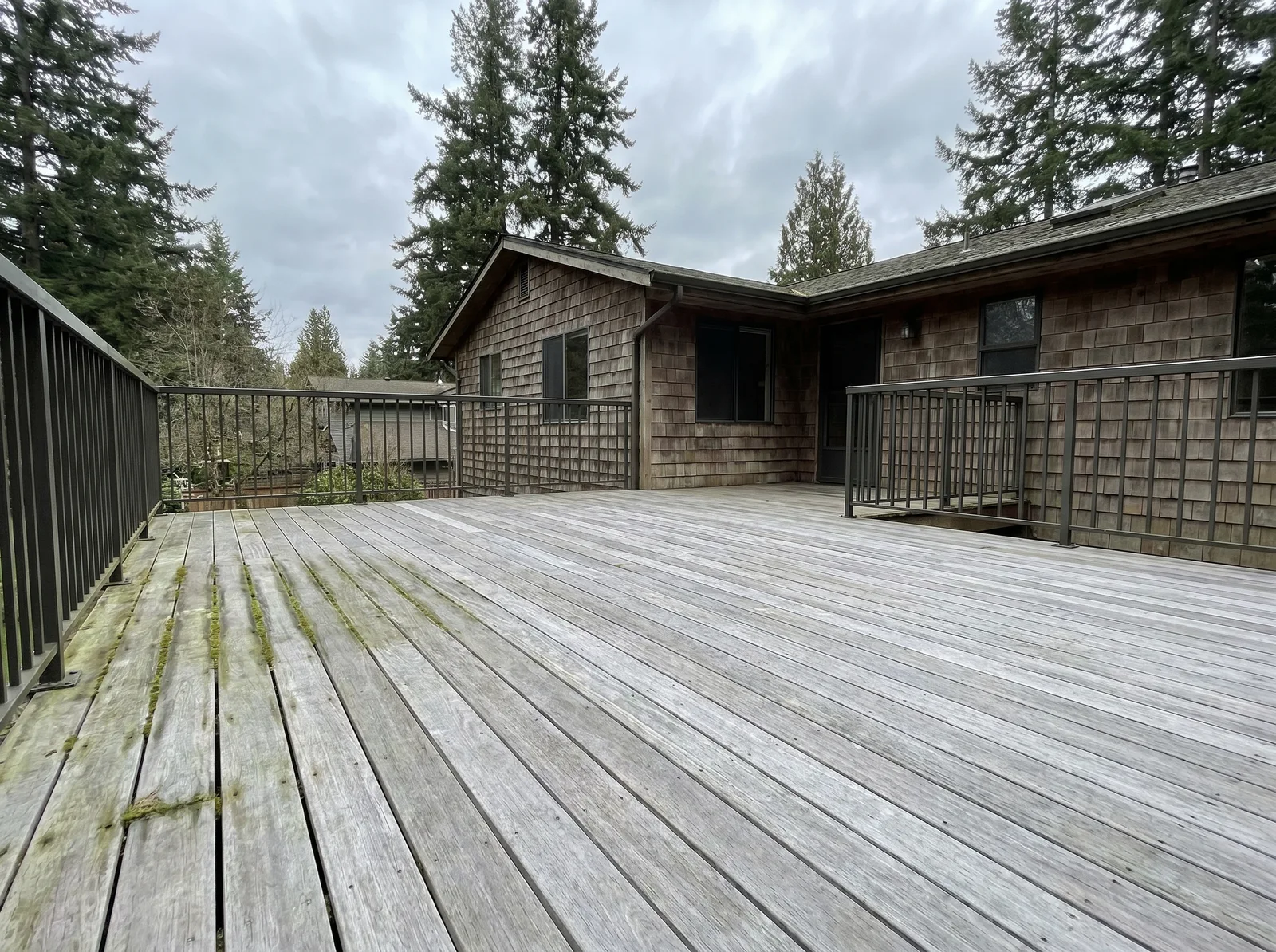
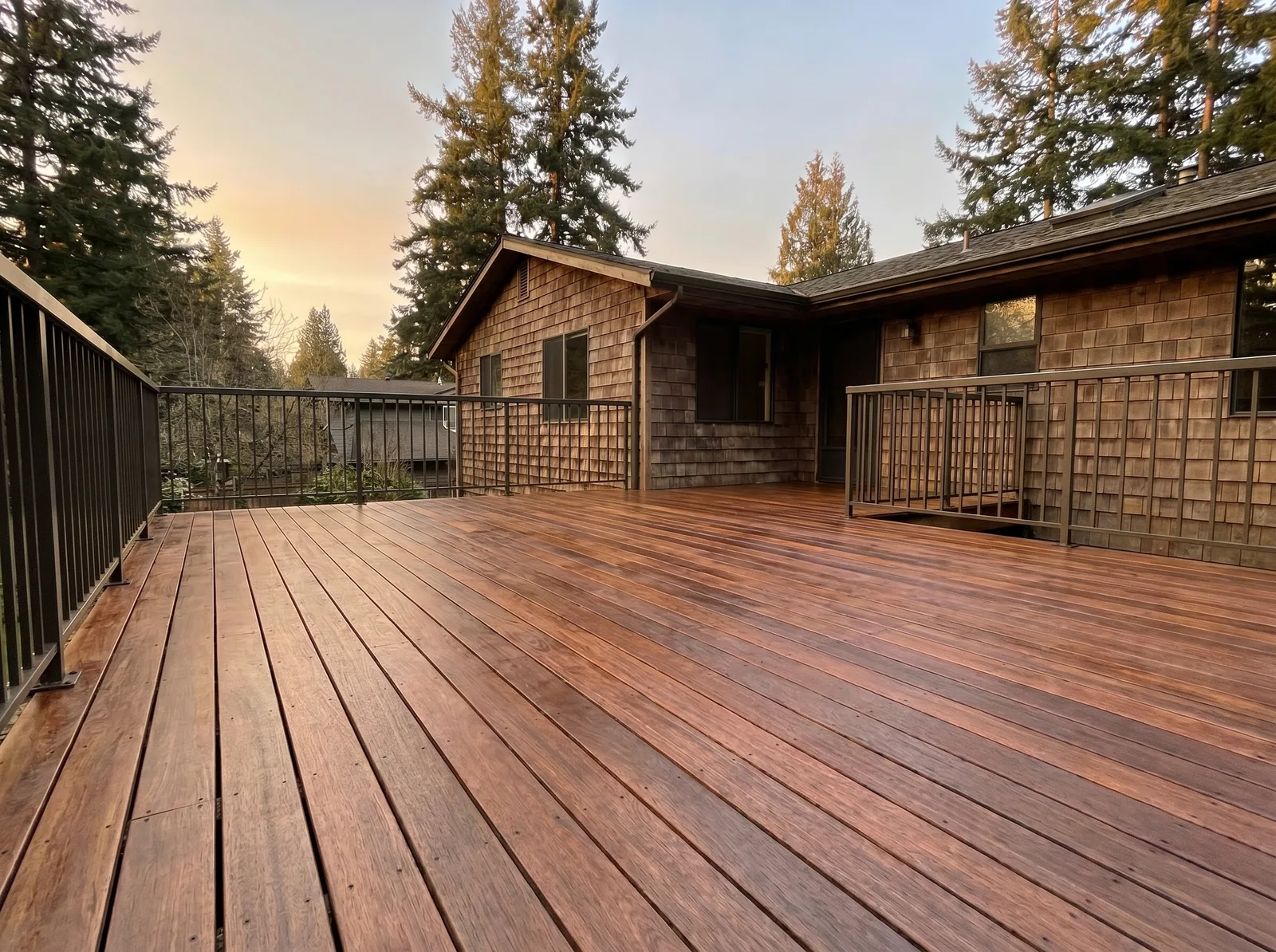
Refurbishment is the service for a deck that has already gone grey or that has old, failing finish on it. The goal is to reset the surface and revive the color in one visit. We work in a deliberate order, and skipping steps is where most do-it-yourself attempts go wrong.
Gentle cleaning, not aggressive pressure washing
The instinct is to blast the grey off with a pressure washer on full power. On Ipe that is a mistake. High pressure raises the grain, fuzzes the surface, and can carve permanent marks into even this hard a wood. We use a low-pressure rinse paired with a cleaner made for hardwoods to lift dirt, mildew, and surface grime without tearing up the boards, and we keep the tip moving with a wide fan rather than a pencil jet. It is the same gentle approach we explain in soft wash versus pressure wash, and it is part of our pressure washing work. Gentle is not just kinder to the wood, it leaves a smoother surface for the oil to sit in.
Brightening to pull out the grey
Cleaning removes the dirt, but the grey discoloration and any cleaner residue need a second step. A brightener, usually an oxalic acid solution, neutralizes the surface and chemically lifts out the weathered tone, pulling the boards back toward their natural reddish-brown. This is the step that does the real color work, and it is the one most people skip. On a Bellingham deck with built-up mildew staining, brightening is what makes the difference between a deck that looks clean and a deck that looks new.
Drying to the dry window
Ipe will not take oil if there is moisture in the wood, and a dense board holds water longer than a softwood. After cleaning and brightening we let the deck dry thoroughly, ideally during a stretch of our dry window from June into September, and we check the boards with a moisture meter rather than going by how they look. Rushing oil onto a damp deck is a guaranteed way to get a blotchy, slow-curing finish. In our climate, patience on drying time is half the job.
Oiling to revive the color
With the deck clean, bright, and dry, we apply a thin coat of penetrating hardwood oil, let it soak in, and wipe off every bit of excess. On dense wood like Ipe, less is more. Flood the surface and the extra oil has nowhere to go, so it stays tacky and never cures. A correctly oiled Ipe deck comes back to that deep, wet-looking brown the day it is done, and it is ready for furniture within about a day.
Still reading? Get a real number for your project instead of a ballpark.
Get a free quoteWhat Ipe Deck Restoration Costs in Bellingham in 2026
Most owners calling about a grey Ipe deck want a number before they want a process. Here is where this work lands against our published Bellingham deck pricing, and what moves a deck from one tier to the next.
What a full Ipe refurbishment runs
A clean, brighten, dry, and oil cycle prices off our deck refinishing range of $3.30 to $6.60 per square foot, and most residential decks in Whatcom County land somewhere in the $770 to $2,000 project range once rails, steps, and spindles are counted. Ipe sits toward the upper half of that per-foot range for two reasons. Hardwood oil costs more per gallon than softwood stain, and the brightening step plus the wipe-off pass on dense boards is slower labor than rolling stain onto cedar. A 300 square foot Ipe deck with simple rails is a different job from a 300 square foot deck with 40 spindles and two stair runs, which is why square footage alone never settles a quote. Our deck staining cost breakdown walks through how those ranges get built.
What the annual oil coat costs
A maintenance visit on a deck already on schedule is the cheapest way to own Ipe. There is no brightening, no stripping, and no multi-day dry-out, so it sits at the bottom of that same range rather than the top. Wash, dry, one thin coat, done. The trade is that you pay it every year instead of paying several times as much every few years to rescue a deck that has gone all the way back to grey. If you want to see how a real deck quote gets assembled line by line, we published an actual Bellingham deck bid with the numbers left in.
What pushes an Ipe deck into restoration pricing
Three things move a deck out of the refinishing range and into full restoration work, which runs $3,500 to $5,500 depending on size and condition. A failed film finish that has to be stripped before anything else can happen. Surface damage deep enough to need sanding back to sound wood. And fastener or framing repair, which on older Ipe usually means plugging, re-screwing, or swapping out corroded hardware. Standalone cleaning with no finish work prices as pressure washing at $385 to $825. Painted posts, railings, or the house wall behind the deck are separate work and price with our exterior painting crew.
Annual Oil Treatment: Keeping the Color You Paid For
Refurbishment brings the color back. Annual oil treatment is how you keep it without ever letting the deck slide back to grey. It is a lighter, faster visit, and it is the smarter way to own an Ipe deck in this climate.
Why Ipe needs oil more often than you would think
Because penetrating oil does not build a thick film, and because Ipe is so dense that it accepts only a shallow layer, there is less finish on the surface to begin with. Our UV and our wet months wear that thin layer down within a year. That is not a flaw in the oil, it is the trade-off that keeps the finish from peeling. The practical result is that Ipe wants a fresh maintenance coat every 6 to 12 months to hold its color, more often than a softwood deck typically needs.
What an annual visit looks like
A maintenance visit is not a full restoration. If the deck has been kept up, we do a gentle wash to clear off the season's grime, mildew, and pollen, let it dry, and lay down a fresh thin coat of the same penetrating oil. There is no aggressive brightening or stripping because the color never got the chance to fade out. It is a half-day kind of job rather than a multi-day project, and it costs accordingly.
Timing it to Bellingham's calendar
The best time for the annual coat is during the dry window, once the heavy spring rain has passed and the boards have had a chance to dry out. The same timing logic applies to staining a softwood deck here. Booking it for early summer means the deck is protected and looking its best heading into the season you actually use it. Wait too long into fall and you are fighting moisture and shorter dry spells to get a clean coat down. We keep Ipe maintenance clients on a yearly reminder so the timing does not slip.
Refurbishment vs. Annual Care: Which Do You Need?
Most decks fall clearly into one bucket or the other, and a quick look tells the story.
Signs your deck needs a full refurbishment
If the deck has gone uniformly grey, if there is peeling or flaking from an old film finish, or if it has been more than a couple of years since anyone touched it, start with refurbishment. The same goes for a deck with heavy mildew staining or a blotchy, half-faded look. These decks need the full clean, brighten, dry, and oil sequence to get back to a clean baseline before any maintenance plan makes sense.
Signs you just need a maintenance coat
If your deck still shows good color with only a slight dulling, or if it was professionally refurbished within the last year, an annual oil treatment is all it needs. Catching it at this stage is the whole point. A deck that gets its yearly coat never has to be rescued, which keeps it looking sharp and keeps your long-term cost lower than letting it grey out and restoring it from scratch.
An Ipe deck is a real investment, and in Bellingham it asks for the right kind of care rather than a lot of it. Clean it gently, brighten it properly, oil it correctly, and keep up with a coat each year, and that deck will hold its deep color for decades. If yours has gone grey or it is coming up on its annual treatment, reach out for a quote and we will get it back on schedule.